Undercarriage & wear parts
Bucket tooth pin diameter: measure it before you order
What a caliper reading actually tells you
Three readings on the same bore can all be correct and still disagree: the largest diameter, the smallest, and the mean. A worn bore is oval, so the largest is the most worn point and the smallest is closest to original. The mean is the least useful of the three, because it describes a hole that does not exist.
This is why the instruction is to take the smaller reading. It is not a rule of thumb — it is the only reading that approximates the dimension the part was made to.
Taper, not just ovality
Bores also wear into a taper along their length, wider at one end. Measure at both ends of the bore as well as across two axes. A bore that is round at one end and oval at the other will accept a new pin and then develop play quickly, because the pin only contacts part of the length.
The pin diameter is the single most common reason a replacement bucket tooth does not fit. It is also the easiest dimension to measure wrongly, because a worn bore is never round.
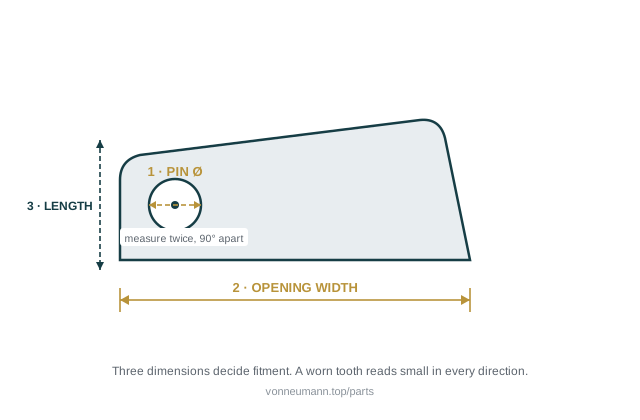
What to measure
- Bore diameter at two perpendicular axes. A worn bore is oval. Take the smaller of the two readings — the larger one is the wear, not the original size.
- Pin length and retention type. Pinned teeth and pinless (adapter-mounted) teeth need different measurements entirely.
- Opening width between the two inner faces where the adapter seats.
The worn-part trap
A worn tooth measures small in every direction. If your part is more than roughly a third worn, do not measure it as a reference — measure a near-new one, or take the dimensions from the machine documentation. Measuring a worn part and ordering to those numbers guarantees a loose fit.
Why "fits PC200" is not enough
Within a single machine model there are usually several tooth and adapter variants depending on bucket type and market. The pin diameter differs between them. A part number, or a photo of the casting mark, resolves this in seconds; a machine model name does not.
What we need to confirm fitment
- Machine make, model and serial number
- Photo of the casting number on the worn part
- Two caliper readings of the bore, at 90 degrees to each other
- Quantity and whether this is a one-off or repeating order
Send these to alfrun@gmail.com and we confirm the part number and the fitment basis before any price discussion. If we cannot confirm it, we say so.
Before you order
Send machine make, model, serial number and a photo of the casting mark. We confirm the part number and fitment basis before any price discussion. If we cannot confirm it, we say so.
Trademark notice
Machine brand names and part numbers are used only to describe fitment and application. We are not an authorised dealer of any machine manufacturer. We do not use manufacturer logos and do not describe parts as genuine, OEM or original.
Reviewed by Zhonglei M&E parts desk — export trading partner for undercarriage and wear parts. Last updated 2026-11-13.