Undercarriage & wear parts
Excavator undercarriage parts diagram: every component, named
The undercarriage is the lowest part of the machine and the highest part of the maintenance cost. This is every component, what it does, and what to measure on each one.
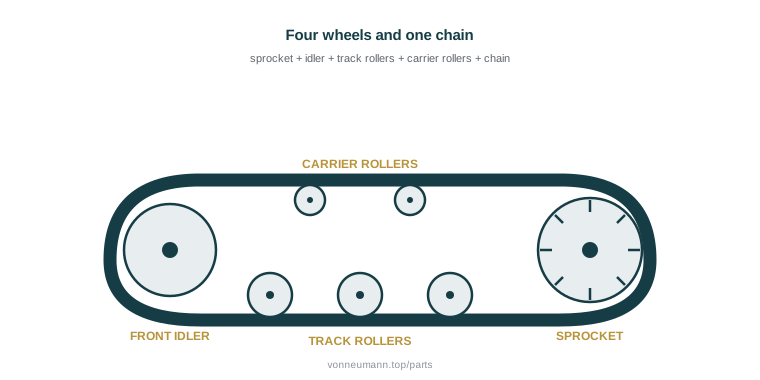
The four running-gear groups
The undercarriage is conventionally divided into four groups — this is the "four wheels and one chain" (四轮一带) grouping used across the industry:
- Drive sprocket — at the rear, driven by the final drive; pulls the chain
- Front idler — at the front; guides the chain and holds tension
- Track rollers (lower rollers) — along the bottom; carry the machine's weight on the chain
- Carrier rollers (upper rollers) — along the top; support the returning chain
- Track chain and shoes — the chain itself, with shoes bolted to the links
Component by component: what each does and what to measure
Drive sprocket
Function: engages the chain and drives it.
Measure: tooth count, chain pitch, tooth section thickness, bolt pattern (segmented or one-piece).
Wear sign: teeth hook over. Once hooked, it destroys the chain — replace with or before the chain, never after.
Front idler
Function: guides the chain at the front and sets track tension.
Measure: rim diameter, shaft diameter, mounting flange spacing, bolt pattern.
Wear sign: tread wear is measurable; bearing and seal failure is not — look for grease weeping at the hub or a wobble.
Track rollers
Also called: bottom rollers, lower rollers.
Function: carry the machine weight and roll on the chain bushings.
Measure: shaft diameter, outer diameter, overall width, flange spacing, press-fit or bolt-on housing.
Wear sign: a leaking roller is more urgent than a worn one — the seal has failed and grit is entering the bearing.
Carrier rollers
Also called: top rollers, upper rollers, support rollers.
Function: support the chain on its return run; fewer and smaller than track rollers.
Measure: same dimensions as track rollers, but do not assume the two are interchangeable — they are different parts.
Track chain and links
Function: the continuous track; transmits drive to the ground.
Measure: link count, chain pitch, pin and bushing wear.
Wear sign: pitch increases as pins and bushings wear — a stretched chain cannot be tensioned within range.
Track shoes (pads)
Function: the ground contact surface.
Measure: width, thickness, bolt hole count and spacing, grouser height.
Wear sign: grouser height below limit reduces traction before it becomes a fitment problem.
Two things get confused here. Grouser count is one dimension: excavators typically run triple grouser shoes, dozers run single grouser. Material is a separate dimension: on finished surfaces the alternatives are rubber pads bolted over the steel shoes, or rubber tracks — a complete rubber belt replacing the steel undercarriage. Those are two different products, not two names for one.
Neither dimension changes the bolt pattern, but both change what you order. Specify grouser type, material, and bolt pattern separately.
Why this grouping matters for ordering
Each group wears at a different rate and for different reasons. Replacing components without understanding which group is failing — and why — is how the same part gets replaced twice. For example, a failing idler may be a symptom of a misaligned track frame, not a bad idler.
Diagnosing which component is at fault
Our guides cover each in detail: track roller wear limits, idler wheel diagnosis, sprocket replacement, track tension.
Confirming a part
Send machine make, model, full serial number, a photo of the casting mark, and the relevant dimensions. We confirm the part number before quoting: alfrun@gmail.com
Before you order
Send machine make, model, serial number and a photo of the casting mark. We confirm the part number and fitment basis before any price discussion.
Confirming the part before you order
Measurements get you close. A serial number and a photograph of the casting mark confirm it. Here is exactly what we need, and why each item matters:
Trademark notice
Machine brand names and part numbers are used only to describe fitment and application. We are not an authorised dealer of any machine manufacturer.
Reviewed by Zhonglei M&E parts desk — export trading partner for undercarriage and wear parts. Last updated 2026-11-13.